
Why Power Comes Before Law
The structural truth of international politics, and why understanding it is not cynicism but clarity

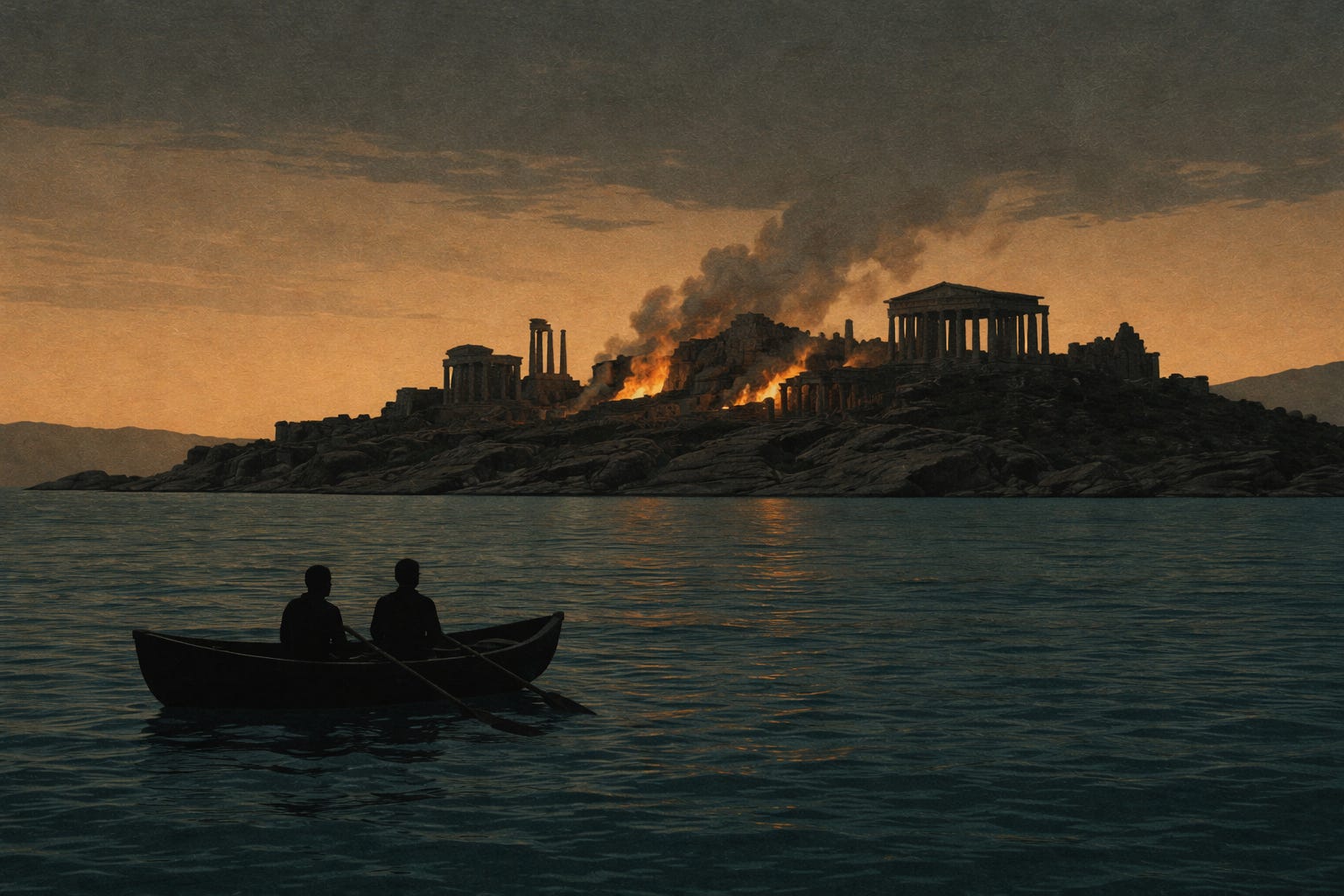
In the summer of 416 BC, Athenian envoys arrived on the island of Melos with an offer the Melians could not refuse. Athens was the dominant naval power in the Aegean. Melos was a small island that had remained neutral in the war between Athens and Sparta. The Athenians wanted Melos to submit and pay tribute. The Melians refused, appealing to justice, to the gods, and to the hope that Sparta would come to their defense.
The Athenians were unmoved. They said something that has echoed through two and a half millennia of political thought: the strong do what they can, and the weak suffer what they must.
Melos fell. The men were killed. The women and children were enslaved. The island was resettled with Athenian colonists.
Thucydides, who recorded this exchange, was not endorsing it. He was describing something. He was telling his readers, then and now, that international politics operates according to a logic that does not disappear when we find it uncomfortable. The Melian Dialogue is not a curiosity from ancient history. It is a recurring pattern. It happened in Melos in 416 BC. It happened in Belgium in 1914, when Germany dismissed its treaty obligations as a scrap of paper. It happened in Crimea in 2014. It happens whenever a state with sufficient power decides that its interests outweigh its commitments.
The question is not whether this pattern exists. It does. The question is what it means and what follows from it.
The Structure No One Controls
International politics has no referee. This is the first and most important fact about the world states inhabit. Within states, there is government: institutions that make and enforce rules, courts that adjudicate disputes, police that compel compliance. A citizen who is wronged can sue. A contract that is broken can be enforced. A criminal who flees can be extradited.
None of this exists between states. There is no world government. There is no authority above sovereign states that can compel them to honor their commitments, punish aggression, or enforce the verdicts of international courts. The United Nations Security Council comes closest to this function, but it is structurally incapable of performing it: its five permanent members each hold a veto, which means the body can only act when the great powers agree, and the great powers rarely agree on anything that affects their core interests.
This condition has a name in political science: anarchy. Not anarchy in the popular sense of chaos or disorder, but anarchy in the precise sense of the absence of a ruling authority. The international system is anarchic because no legitimate power stands above the states within it.
From this structural condition, a set of consequences follow that are not pleasant but are real.
The first consequence is that states must ultimately provide for their own security. No one else will do it reliably. Alliances help, and the history of successful alliances is not trivial. But alliances are instruments of interest, not guarantees of salvation. They hold when holding serves the interests of the members. When it does not, they fracture. France and Britain were allied in 1940. Britain survived; France fell. The difference was not the alliance. The difference was geography, leadership, and the decisions of individual men under extreme pressure.
The second consequence is that law in international politics derives its force from power, not the other way around. This is the sentence that most people resist, because it sounds like an argument for lawlessness. It is not. It is a description of how legal order actually works.
Why Law Follows Power
Consider the body of international law that governs warfare: the Geneva Conventions, the prohibition on the use of chemical weapons, the laws of occupation. These rules are real. They are violated regularly, but they are also followed regularly. Armies that could massacre prisoners often do not. Civilians are sometimes protected. Medical facilities are sometimes respected.
Why? Not primarily because states fear prosecution. The International Criminal Court has existed since 2002, has issued hundreds of arrest warrants, and has secured a small number of convictions against officials from small states. The United States, Russia, and China have not ratified the Rome Statute. No permanent member of the Security Council has ever faced meaningful legal accountability for its military actions. The legal architecture of international humanitarian law is real, but its enforcement depends not on courts but on reciprocity, reputation, and the military capacity of states to make violations costly.
Laws of war are followed, when they are followed, because states calculate that following them serves their interests: maintaining the morale of their own troops, preserving the possibility of negotiated settlements, avoiding retaliation in kind, and sustaining the domestic and international legitimacy they need to continue fighting. The laws do not compel this behavior from above. The behavior sustains the laws from below, as long as the underlying interests remain aligned.
The same logic applies to trade agreements, arms control treaties, and diplomatic conventions. The nuclear Non-Proliferation Treaty has held, imperfectly, for over fifty years. It has held not because states are bound by law but because the major nuclear powers have consistently signaled, through deployment decisions, intelligence sharing, and occasional military action, that proliferation will be resisted by force if necessary. The treaty codified a power arrangement. The power arrangement sustains the treaty.
When the power arrangement changes, the treaty follows. The collapse of the Soviet Union did not produce a stable nonproliferation order through legal continuity. It produced North Korea, a near miss in Ukraine, and a decades-long negotiation with Iran that reflected not legal logic but the shifting interests of the United States, Russia, China, and the European powers.
None of this means that international law is worthless. It means that international law is an instrument of order, not its foundation. The distinction matters enormously.
The Honest Realist Position
At this point, two objections typically arise.
The first objection is moral: if power comes before law, then might makes right, and there is nothing to say against aggression except that you lost. This objection misunderstands the argument. Recognizing that power is the structural foundation of international order does not mean endorsing any particular use of power. A doctor who understands that disease kills does not endorse disease. A structural analysis is not a moral prescription.
The second objection is empirical: if power determines everything, why do weaker states survive? Why does Costa Rica exist? Why has Switzerland remained neutral through two world wars while more powerful neighbors were destroyed? The answer is that power is not the only variable. Geography, economic utility, the costs of conquest, the distraction of great powers elsewhere, and above all the existence of overlapping great power interests in maintaining certain small states all explain why Costa Rica is not absorbed by its larger neighbors. But note: these explanations are themselves power-based. Costa Rica survives not because international law protects it but because no sufficiently powerful state has a sufficient interest in eliminating it, and because the United States, for over a century, has made clear that it considers the stability of Central America part of its sphere of interest.
The honest realist position is not that power is good. It is that power is primary. Confusing this with moral endorsement is a category error that produces bad analysis and worse policy.
But Order Is Real
Here is where the standard realist account becomes insufficient, and where the analysis has to go further.
If power determined everything, order should be perpetually unstable. Strong states should constantly prey on weaker ones. Alliances should dissolve the moment circumstances change. Agreements should be honored only at gunpoint. Yet this is not consistently what we observe.
States cooperate. Alliances persist. Institutions function for decades. Germany and France have not gone to war since 1945, after fighting three major wars in seventy-five years. The pattern of European integration, whatever its current difficulties, represents a transformation in how European states relate to one another that no pure power analysis adequately explains.
Order is real. But it is not self-sustaining, and it is not generated by law or norms acting independently of power. Order is produced. It is made by states, usually great powers, that find it in their interest to create and maintain stable arrangements, and it is sustained by the convergence of interest and sometimes by something deeper: shared political culture, common institutional frameworks, and accumulated habits of cooperation that make defection increasingly costly.
This is the first step toward a more complete theory. The anarchic structure of international politics is a permanent condition. But within that structure, different outcomes are possible. Some coalitions endure. Some institutional arrangements persist through stress. Some collective actors behave with genuine strategic coherence. Others fragment at the first test.
The question is not whether power matters. It does. The question is what kind of order power can produce, under what conditions, and how durable that order is. That question cannot be answered by the Melian Dialogue alone.
The Space of Political Reason
The Athenians were right about one thing: the strong do what they can. But Thucydides was writing a tragedy, not a manual. Athens itself was destroyed twenty years later. Its overreach in Sicily, its internal democratic failures, its inability to sustain the coalition of interests that had made it powerful: these too are part of the story. Power without order is chaos. Order without power is illusion. Between these two poles lies the space of political reason.
Political reason in international affairs means understanding the structural constraints within which states operate and working within them without being paralyzed by them. It means recognizing that international law is an instrument, not a foundation, and using it accordingly. It means building collective arrangements that can survive beyond the immediate interest convergence that created them. And it means being clear about the difference between what you wish were true and what is actually true.
Most political failures in international affairs come not from insufficient idealism but from insufficient realism. States overestimate the durability of alliances built on temporary interests. They mistake institutional form for substantive cohesion. They assume that because an agreement exists on paper, the interests sustaining it still hold. When the interests shift, the agreement collapses, and they are surprised.
The Athenians were not surprised by what happened to Melos. They had done the analysis. What they failed to do, and what ultimately destroyed Athens, was to apply the same analysis to themselves.
Power comes before law. That is the starting point. What comes after that starting point, what kind of order emerges from power, how it is built, and what makes it last, is the real question. It is the question that the rest of this project tries to answer.