
What Bombs Cannot Do
Seven days in, the air campaign is working. The political question it was supposed to answer is not.

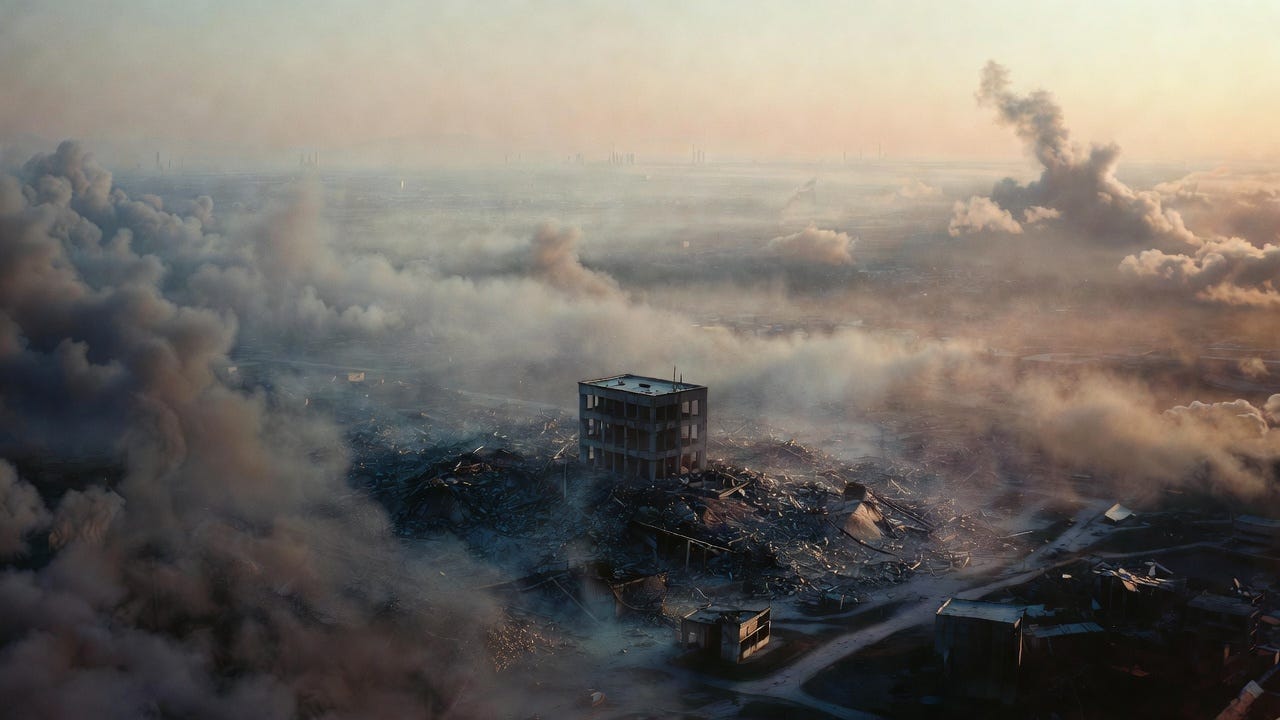
Seven days in, the US-Israeli campaign against Iran has achieved something remarkable and something troubling in equal measure. The military results are extraordinary. The political logic behind them is falling apart.
Nearly 2,000 targets have been hit. The Strait of Hormuz is closed. The fighting has spread to Lebanon, Iraq, the Indian Ocean, and the skies above half a dozen Gulf states. Iran’s military is degrading at a pace that would have seemed implausible a week ago. And yet there is no ceasefire in sight, no coherent endgame, and a regime in Tehran that is more consolidated around its hardest elements than it was before the first bomb fell.
To understand how those two things can be simultaneously true, it helps to look at what the campaign has actually done, and what it has not.
Three Phases, One Problem
The air campaign has moved through three distinct phases. The first two days focused on suppressing air defenses and killing leadership. Khamenei’s compound took thirty bombs. IRGC headquarters was flattened. Over 200 air defense systems were destroyed. By March 2, the US had established effective control over the skies above western Iran and Tehran. B-1B bombers began hitting deeper targets. Non-stealth aircraft, F-15Es and F-16s, entered Iranian airspace. MQ-9 Reapers began flying combat missions. Phase three has now begun. The goal is to push further inland and go deeper.
The numbers are significant. Israel has flown 1,600 sorties and dropped 4,000 munitions. US CENTCOM has hit nearly 2,000 targets. The target list extends well beyond military infrastructure: state television, parliament, police stations in more than fifteen cities, the Assembly of Experts building in Qom, struck while it was voting on Khamenei’s successor. The US fired the Precision Strike Missile in combat for the first time. On March 4, a US submarine torpedoed and sank the Iranian frigate IRIS Dena off Sri Lanka, the first American submarine torpedo kill since World War II. An Israeli F-35I shot down an Iranian combat aircraft over Tehran, the first F-35 air-to-air kill in history.
Iran’s ability to respond is collapsing. Ballistic missile launches dropped 86 percent from day one. Drone launches fell 73 percent. The 150-missile waves of February 28 have shrunk to barrages of nine to thirty. For all practical purposes, Iran is now defenseless against air attack.
This is where the problem begins. Military dominance and political resolution are not the same thing. The campaign has destroyed Iran’s capacity to fight. It has not destroyed the regime. And the regime, stripped of its conventional military capacity, has reorganized around its hardest and most ideologically committed elements.
The Succession That Changed Nothing
Khamenei’s death triggered Iran’s second leadership transition since 1979 and its first during a war. The constitution provided for an Interim Leadership Council composed of President Pezeshkian, Judiciary Chief Mohseni-Ejei, and Ayatollah Arafi. In practice, Ali Larijani, head of the national security council, has been running operations for months. The formal council is a procedural shell around a power structure that was already in place.
The succession itself was coerced. The IRGC pressured the Assembly of Experts to select Mojtaba Khamenei, the former Supreme Leader’s son, via unprecedented online voting. Roughly ten percent of the Assembly refused to participate, calling the process invalid and accusing the IRGC of orchestrating a coup. The accusation is not entirely wrong. Mojtaba joined the IRGC at seventeen during the Iran-Iraq war. The men who served alongside him hold senior positions throughout Iran’s security and intelligence apparatus. For at least twenty years he ran the Office of the Supreme Leader, the institution that controls appointments to the country’s top security and judicial positions and manages access to secret funds. He was the main channel between Khamenei and IRGC leadership for decades. He never held formal office. He never ran for anything. He never needed to.
Washington hoped that killing Khamenei would fracture the regime. What it produced instead was a transition that handed formal power to the faction that was already running the country informally. Iran’s own Foreign Ministry admitted it had lost control over some military units, a clear reference to the IRGC. That admission is telling. The civilian government acknowledges it does not control the military. The military has now installed its preferred figure as Supreme Leader. The IRGC is not one element of the Iranian regime. It is the regime.
Killing Khamenei was never going to change that. One thousand IRGC personnel have been killed in six days of strikes. Out of two hundred thousand. The institution is intact.
Five Fronts
The regional spillover is significant and accelerating. Five fronts are now active simultaneously: Lebanon, Iraq, the Gulf, the Indian Ocean, and the Strait of Hormuz. Each is moving in its own direction.
Hezbollah fired rockets and drones at three Israeli bases on March 2, its first cross-border attack since the November 2024 ceasefire. Israel responded with approximately 250 strikes and crossed into southern Lebanon with the 91st Division on March 3. Seventy-seven dead, 527 wounded, 300,000 displaced. The Lebanese government officially banned Hezbollah’s military activities and ordered it to disarm. This means nothing. It never has.
In Iraq, US and Israeli strikes on Tehran-backed militias produced over seventy missiles and drones in return. Iran’s retaliatory campaign hit Gulf infrastructure across six countries. The IRGC launched an estimated 500 ballistic missiles and more than 2,000 drones in four days, targeting US military sites and civilian landmarks. Two drones hit the US embassy in Riyadh. Six US soldiers died in Kuwait. The UAE pulled its ambassadors from both Tehran and Tel Aviv. Multiple intelligence agencies believe the IRGC acted on several of these strikes independently, and expressly against the orders of the official Iranian government.
The Houthis have not yet moved. The group is split between hardliners wanting to resume Red Sea attacks at scale and moderates who want to preserve their arrangement with Saudi Arabia. That internal struggle is unresolved.
The Strait of Hormuz closed with cheap drones. Tanker traffic fell from fifty vessels on February 28 to three on March 1, all Iranian-flagged. Maritime insurers pulled war risk coverage. Without insurance there is no transit. Brent crude is up 17 percent. US gas prices jumped 22 cents per gallon, the fastest spike since Russia invaded Ukraine. QatarEnergy suspended LNG deliveries after shutting its two main facilities, removing roughly 20 percent of global LNG supply from the market overnight. European gas futures nearly doubled. Iraq began shutting down its largest oil field because it had nowhere to send crude that could not leave through Hormuz. Every day the strait stays closed, the economic damage compounds.
The Endgame Nobody Can Name
The honest problem with Washington’s position is that nobody knows what the endgame is. The administration’s stated objectives have shifted at least four or five times since the campaign began. Nuclear program. Ballistic missiles. Regime change. Sinking the navy. Then all of the above. Hegseth says this will not be a forever war and also says it could last eight weeks. Trump says four to five weeks and also far longer. The Venezuela model has been floated: parts of the existing government cooperating with Washington after a leadership change. Iran is not Venezuela. It is larger, more heavily armed, and incomparably more complex.
Rubio has pushed a narrower framework: destroy the missiles, destroy the drones, sink the navy. That is achievable from the air. Regime change is not. If regime change is truly the objective, it eventually requires ground forces. That is a line no one in this administration wants to cross, and there is no sign that Congress or the American public would support it. Seventy-four percent of Americans oppose sending ground troops.
The contradiction is structural. The campaign was designed to produce a political outcome, regime change or capitulation, that airpower alone cannot deliver. Washington appears to be searching for a proxy solution. Multiple outlets have reported CIA efforts to arm Kurdish forces in northwestern Iran. There are unconfirmed reports of a Kurdish ground offensive near Marivan. Kurdish officials have denied it. The White House says Trump has not approved any such plan. Kurdish fighters can destabilize Iran’s western periphery. They cannot march on Tehran. They cannot topple a regime with 200,000 IRGC personnel and a security apparatus purpose-built for exactly this scenario.
The Ceasefire That Cannot Happen Yet
Diplomacy is not dead. But it is paralyzed by the same internal fracture that defines everything else about Iran’s current condition. President Pezeshkian wants to talk. He has reached out to neighbors. He has framed Tehran’s military campaign as a last resort. He clearly wants an exit. On the other side, the IRGC and the hardliners around Larijani and Mojtaba Khamenei want to keep fighting. For them this is not strategy. It is survival. Any ceasefire before the US and Israel pay a serious price looks like surrender, domestically and regionally. The IRGC’s institutional identity is built on resistance. Stopping now dismantles that identity.
The result is that Iran is speaking with two voices simultaneously, and neither voice has full authority over the other. Some Iranian officials contacted the CIA asking for a truce. Tehran officially denied it. Larijani doubled down and said Iran would keep fighting. No mediator can bridge positions held by parties within the same government that are actively contradicting each other.
Netanyahu has no interest in a ceasefire. Israeli politicians across the spectrum support the operation. Defense Minister Katz has said any successor to Khamenei is a legitimate target. Israel sees this as the last round with Iran and is not stopping until the job, by its own definition, is done. That puts Washington in an uncomfortable position. Even if Trump wanted an exit, Tel Aviv would resist it. And as long as Israel keeps striking, Tehran has no incentive to come to the table.
Iran’s missile stockpiles are running low. Its launchers are being destroyed faster than it can hide them. The kinetic phase of this war could wind down within days simply because Iran will have little left to fire. What comes after that moment is the question nobody in Washington, Tel Aviv, or Tehran has answered.
Military dominance has been established. The regime has not collapsed. The enriched uranium is still under Isfahan. The Strait of Hormuz is still closed. The IRGC is intact as an institution and has just installed its preferred figure as Supreme Leader. What the campaign has produced is a weaker Iran organized around its hardest elements, a regional economic crisis, and a political problem that no amount of airpower has come close to solving. The bombs have done what bombs can do. Everything that comes next is beyond their reach.