
The Day After the Bombs
The largest air campaign in a generation has begun. The question was never whether it would work militarily. It was always what comes after.

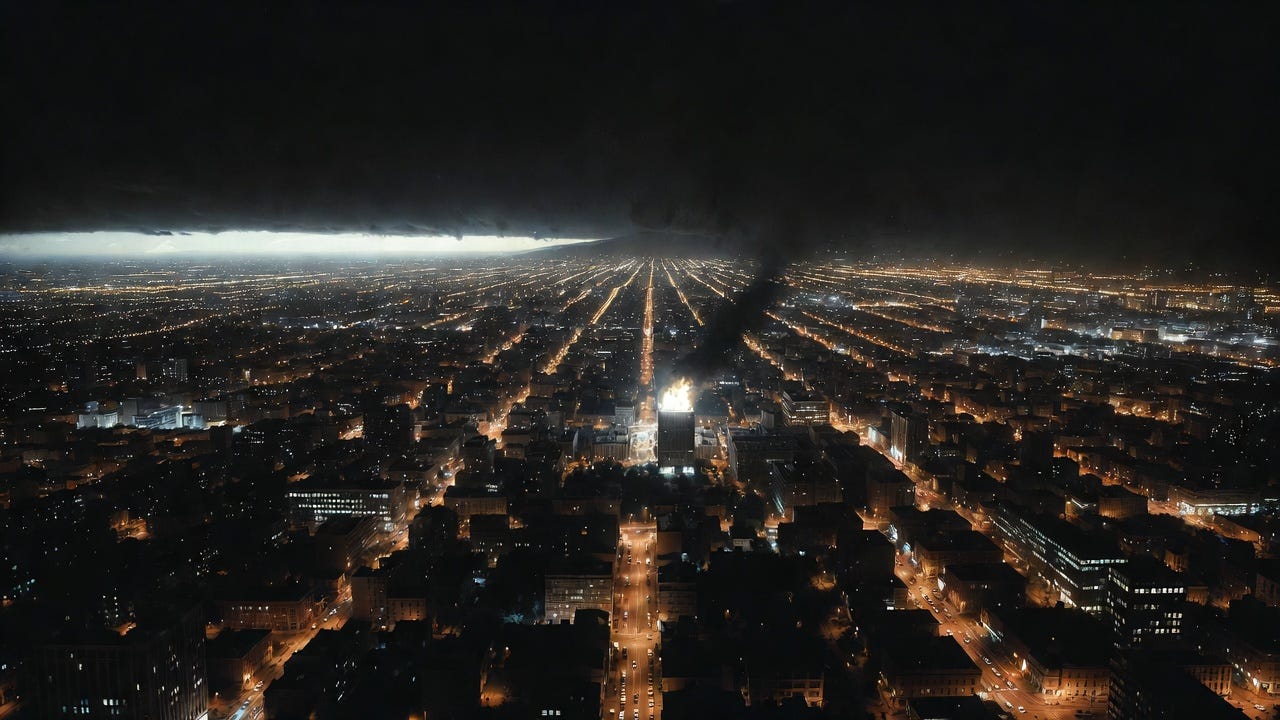
The United States and Israel have launched the largest combined air campaign in the Middle East since the 2003 invasion of Iraq. Supreme Leader Ali Khamenei is dead. Most of Iran’s senior military leadership is dead. Strikes have hit 24 of Iran’s 31 provinces. And the fighting is still ongoing.
This did not come from nowhere. Three separate dynamics converged over the course of 2025 and early 2026 to make this moment not just possible but, in retrospect, close to inevitable. Understanding those dynamics is the only way to understand what is actually happening now, and what is likely to happen next.
Three Roads to February 28
The first dynamic was the nuclear problem. In June 2025, Israel struck Iranian nuclear and military sites in Operation Rising Lion. Washington followed with Operation Midnight Hammer, seven B-2 bombers dropping bunker-busting munitions on Fordow and Natanz while Tomahawk cruise missiles hit Isfahan. A ceasefire came after twelve days. A subsequent Pentagon review found the strikes had set Iran’s program back approximately two years. The IAEA then assessed that Tehran had enough enriched uranium for around ten warheads and could produce enough fissile material for a single device in under a week. After June, Iran cut off IAEA access, began rebuilding, and moved operations deeper underground. Iranian Foreign Minister Araghchi claimed full reconstruction only weeks ago. From Washington’s perspective, the June 2025 campaign solved nothing. It bought time that Iran used to dig deeper.
The second dynamic was Iran’s internal collapse. On December 28, 2025, the largest protests since 1979 erupted across all 31 provinces. The rial crashed. Inflation topped 42 percent. Food prices became unbearable. By early January, protests had spread to over 110 cities. The crackdown came between January 8 and 10: live ammunition, a full internet blackout, an official death toll of 3,117. Internal Health Ministry estimates exceeded 30,000. The regime was more unpopular than at any point in its history. Trump warned publicly that the crackdown could trigger a US military response. For Washington, a regime facing existential internal pressure was a regime potentially susceptible to external shock. That calculation changed the strategic calculus in ways the June 2025 strikes had not.
The third dynamic was the failure of diplomacy. Three rounds of indirect talks took place in February, in Muscat and twice in Geneva. The US demanded permanent zero enrichment, missile limits, and full proxy dismantlement. Iran offered a three year enrichment freeze and elimination of its 60-percent-enriched stockpile, but refused permanent zero enrichment, which Tehran regarded as a sovereign right under the Nuclear Non-Proliferation Treaty. On February 26, Oman’s foreign minister said significant progress had been made. Within hours, Trump said he was not satisfied. Two days later, the strikes began.
The demands were maximalist by design. US envoys Steve Witkoff and Jared Kushner told Trump a deal on those terms would be nearly impossible. That was not an accident. Every previous confrontation between Trump and Iran, the 2018 nuclear deal exit, the 2020 killing of Soleimani, the June 2025 strikes, had produced manageable consequences. Each cycle made the administration incrementally less risk-averse. And for the first time, regime change in Tehran was being discussed seriously in Washington, something explicitly ruled out during last year’s twelve-day war. Iran’s internal chaos had opened a door that previous administrations had kept firmly closed.
The Scale of the Operation
The campaign is unprecedented. Roughly 900 combined strikes were executed in the first twelve hours. The Israeli Air Force flew its largest mission in history, approximately 200 jets hitting around 500 targets in western Iran, dropping over 1,200 munitions in 24 hours. Washington deployed its largest Middle Eastern force since 2003. Two carrier strike groups, the Lincoln and the Ford, lead the naval component. Over 150 aircraft and dozens of warships firing Tomahawks were involved. All six branches of the US military participated. One-way attack drones were used in US combat operations for the first time.
US strikes targeted IRGC command centers, air defenses, missile sites, airfields, weapons factories, and naval assets. Israel went after leadership. Israeli intelligence had information about a high-level gathering at Khamenei’s compound in Tehran’s Pasteur neighborhood. The strike killed the 86-year-old Supreme Leader, his daughter, and his grandchild, all confirmed by Iranian state media. Also killed: the Defense Minister, the IRGC Commander, the Security Council Secretary, the Chief of Staff, and at least 40 officials in total. Tel Aviv assessed it had eliminated a majority of Iran’s top military leadership in the first wave.
The campaign reached cities across the country. Tehran, Isfahan, Qom, Karaj, Kermanshah, Tabriz, Shiraz, and a dozen others. In the capital, the Ministry of Intelligence, Ministry of Defense, the Atomic Energy Organization, the Parchin military complex, and the Tehran Revolutionary Court were destroyed. The deadliest single incident was a strike on a girls’ school in Hormozgan Province. Between 108 and 148 children were killed. That single incident will define how much of the world remembers this campaign, regardless of what the target list says. Military success and political cost are not the same ledger. The operation is writing on both simultaneously.
Iran’s Response
Iran’s retaliation was immediate and unprecedented in its own right. For the first time in its history, Tehran simultaneously struck almost every US military base in the Persian Gulf. Six waves of attacks used ballistic missiles, Fattah hypersonic missiles, cruise missiles, and Shahed drones against installations in Bahrain, the UAE, Qatar, Kuwait, Jordan, Saudi Arabia, Iraq, and Israel.
The UAE alone faced 165 ballistic missiles, 152 of which were intercepted, along with 541 drones of which 506 were destroyed. Dubai International Airport halted flights indefinitely. A drone struck a tower near the US Fifth Fleet headquarters in Bahrain. Kuwait’s Ali al-Salem Air Base took damage. Two missiles came close to British bases in Cyprus. Approximately 40 missiles reached Israeli territory. Nine were killed in Beit Shemesh, one in Tel Aviv, 89 injured. The IRGC declared the Strait of Hormuz closed. Maersk, CMA CGM, and Hapag-Lloyd suspended all transits. At least 150 tankers are now anchored outside the waterway.
The scale of Iran’s response reflected not strength but desperation. Firing everything simultaneously against every available target is not a coordinated military strategy. It is the action of a command structure that knows it may not have long to act and is trying to establish costs before that window closes.
Why Each Side Is Here
Each party entered this conflict with a distinct internal logic. None of those logics required the other side’s cooperation to function. That combination is what makes the situation so difficult to resolve.
Washington’s public rationale centered on Iran’s nuclear and missile programs. In his February 24 State of the Union, Trump claimed Iran was developing missiles that could soon reach the continental United States. A 2025 US intelligence assessment placed Iranian ICBM capability at approximately 2035. The gap between the public claim and the intelligence assessment is not incidental. The administration’s demands were structurally designed to be unacceptable, which meant the diplomatic track was always likely to produce a military one. What changed in 2026 was the addition of regime change as a serious objective, a shift made possible by Iran’s internal collapse and by an administration that had absorbed the lesson, rightly or wrongly, that confrontation with Tehran produces manageable consequences.
Netanyahu’s calculation was more specific. Since October 7, Israel has operated under a lowered threshold for preemptive action. Iran was moving its nuclear infrastructure underground. Future strikes would be substantially less effective than current ones. The longer Israel waited, the closer Iran came to the point where its nuclear capability would be effectively untouchable. Iran’s proxy network, significantly weakened by Israel’s 2024 and 2025 campaigns, risked partial recovery given time. And Israel’s elections are scheduled for October 2026, with Netanyahu’s coalition behind in polling and lacking a parliamentary majority. The incentive structure pointed in one direction.
Iran’s position was defensive and, in retrospect, fatally misjudged. Tehran’s strategy was to make limited concessions while preserving its enrichment capability, betting that it could outlast Trump’s term. Some Iranian officials believed this approach was working. They were wrong. Simultaneously, the regime was managing an internal crisis of unusual severity. The December protests were unlike anything it had faced in decades. The crackdown stabilized the streets but deepened the government’s unpopularity. Like Netanyahu, Iranian leadership needed a political victory. Unlike Netanyahu, it had no military path to one.
The Silence of the Proxies
Despite being central to Iran’s regional strategy for decades, Tehran’s proxy network has been conspicuously inactive in the first 48 hours. Hezbollah condemned the strikes but launched no retaliatory attacks. The Houthis raised alert levels and announced a resumption of their Red Sea campaign. Nothing followed. Iranian-backed groups in Iraq began mobilizing but have made no significant moves.
The silence reflects structural reality. Communication channels between Tehran and its proxies are either penetrated by Israeli intelligence or no longer functional. Missile stockpiles across the network are at dangerous lows, depleted by Israel’s 2024 and 2025 campaigns and cut off from resupply by the fall of the Assad regime. If these groups do nothing, they lose popular legitimacy. If they act with what they have, they risk being destroyed. That is not a strategic choice. It is a trap.
The World Responds, and It Does Not Matter
China and Russia condemned the operation jointly. Beijing called the killing of a head of state unacceptable. Putin described Khamenei’s death as a cynical act. European governments found themselves in the familiar position of not fully endorsing the strikes while also criticizing Iran’s retaliatory attacks on Gulf states. The UK confirmed its air force participated in some defensive operations in Qatar while refusing Washington access to British overseas airbases. Every capital has a position. None of them has leverage.
Gulf states illustrate this most clearly. They hosted the US bases that attracted Iranian attacks and had no role in the decision to strike. Saudi Arabia had previously told Tehran it would not allow its airspace for attacks on Iran. Saudi Arabia itself then came under fire. Oman was the only GCC country Iran did not target. Not because of military capacity. Because it was mediating. In a war where every other country in the region was either a target or a bystander, Oman’s neutrality was purchased through usefulness. That detail captures the region’s actual logic more precisely than any diplomatic statement issued this week.
Washington holds a Security Council veto. Any resolution, regardless of how many countries back it, is dead on arrival. Israel has long since stopped making strategic decisions based on what European capitals think. International criticism is a constant in Tel Aviv’s strategic environment, not a variable. The world can respond. It cannot redirect.
What Iran Has Left
The honest answer is: not much. The June 2025 strikes destroyed a significant portion of Iran’s ballistic missile stockpile. Tehran reportedly rebuilt its medium-range arsenal to pre-war levels before February 28. This latest campaign has almost certainly degraded those stockpiles again. Iran’s air defenses are effectively gone. An MQ-9 Reaper was spotted circling Shiraz, a city deep inside Iran, a sign that would have been unthinkable twelve months ago. Tehran’s navy is largely a coastal force, capable of harassing shipping in the Strait of Hormuz but not of sustaining a confrontation with two US carrier strike groups.
The Strait of Hormuz is Iran’s strongest remaining card. Closing it shuts down 20 percent of global oil supply. But it is a double-edged instrument. It hurts China, India, Japan, and South Korea as much as it hurts the West. Those are the countries Tehran most needs on its side.
Iran is also decapitated. Khamenei is dead. So are most of the senior military and security officials who would normally coordinate a sustained response. The interim leadership council is not a war cabinet. Decision-making is fragmented at precisely the moment it needs to be coherent. Tehran is fighting this war with what it had yesterday. And what it had yesterday was not enough.
The Question the Campaign Cannot Answer
The operation has achieved, in 48 hours, what no previous strike package against Iran had managed. Khamenei is dead. The senior military command is decimated. Air defenses are gone. The nuclear program has been set back significantly. By every conventional military measure, the campaign has succeeded.
What it has not done is answer the question that comes after military success: what next? Washington’s objectives have already shifted multiple times. The administration entered with demands it knew were unacceptable, escalated to regime change, and is now watching a decapitated Iranian state improvise a response with depleted stockpiles and fragmented command structures. The regime is wounded. It is not dead. The IRGC, with 200,000 personnel, is institutionally intact. The enriched uranium is still somewhere under Isfahan.
Military campaigns answer the questions they are designed to answer. The question of what Iran looks like the day after the bombs stop, who governs it, whether the IRGC consolidates power in the vacuum, whether the nuclear program reconstitutes itself underground, whether the Strait of Hormuz reopens, those questions were not answered by the strike packages that left the Lincoln and the Ford two days ago. They were deferred.
That deferral is now the central problem of the war.