
Built to Break
The Middle East's security order was always a coalition of convenience. The war is proving it.

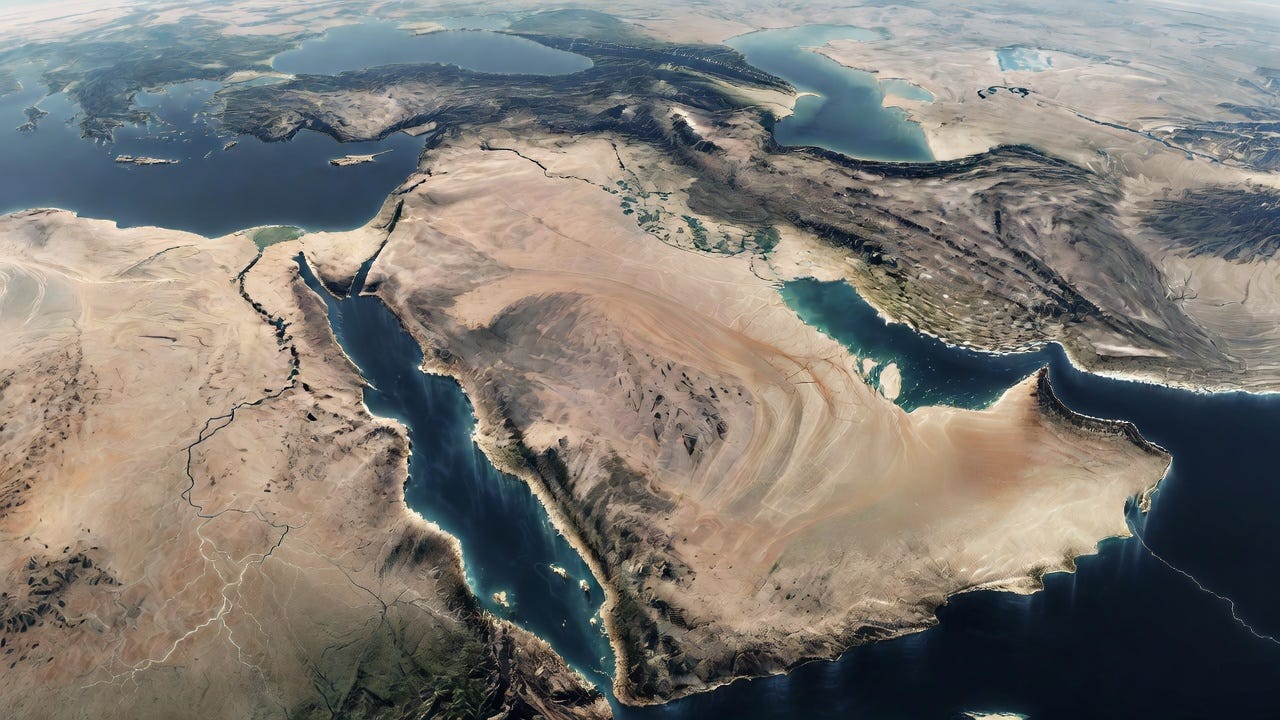
The order that governed the Middle East for three decades was not built on shared values or common ground. It was built on structural convenience. That is why it is now breaking apart.
The US-Israel-Iran war is entering its fifteenth day. The immediate military dimensions are significant. Iran’s nuclear program has been set back. Its proxy network is shattered. The IRGC has taken severe losses. But the more consequential story is not happening on the battlefield. It is happening in the foreign ministries of Riyadh, Abu Dhabi, Ankara, and Cairo, where governments are looking at a regional order they once took for granted and concluding, calmly and methodically, that it no longer works.
To understand why, it helps to start with what that order actually was.
The Architecture of Convenience
The Middle East’s post-Cold War security architecture rested on three interlocking arrangements. First, the petrodollar system: Washington guaranteed the security of Gulf monarchies, and in return those monarchies priced oil in dollars and recycled their wealth into Western financial markets. Second, the containment consensus: a broad, informal coalition of Gulf states, Israel, and Western powers that kept Iran isolated and regionally constrained. Third, the Abraham Accords: a formalization of the Israel-Gulf alignment, built on the logic that a common Iranian threat could override the unresolved Palestinian question.
All three arrangements shared a structural feature. They were held together by external pressure, not by internal coherence. They worked as long as the shared threat remained credible and the costs of cooperation stayed manageable. None of them rested on genuine common ground between the parties involved. They were coalitions of convenience: useful while the incentives held, fragile the moment those incentives shifted.
The war has applied that stress. And the arrangements are responding accordingly.
The Petrodollar Fracture
The clearest case is the petrodollar system. The logic was straightforward: US military presence in the Gulf underwrote the security of Gulf monarchies, and those monarchies kept global energy trade denominated in dollars. That logic required the US umbrella to be credible. It also required US forces to represent protection rather than exposure.
Both assumptions are now in question. Iran has fired missiles and drones at all six GCC countries plus Jordan. Dubai International Airport shut down. Saudi Arabia’s Ras Tanura refinery went offline. Qatar declared force majeure on LNG production. Bahrain intercepted 112 missiles and 186 drones. The UAE shot down 161 out of 174 missiles it detected. These are not symbolic provocations. They are the direct result of US military presence on Gulf soil. Iran’s logic is explicit: if you host American forces, you are in the war, whether you chose to be or not.
The protective relationship has become a targeting relationship. Gulf sovereign wealth funds that had committed enormous sums to American industry are now calculating whether that money should go toward domestic reconstruction and military procurement instead. China, which built strategic oil reserves for 104 days of coverage before the war began, is offering an alternative. Tehran has signaled willingness to allow some tanker traffic through the Strait of Hormuz provided buyers pay in Chinese yuan. Beijing did not need to engineer this moment. It only needed to be ready for it. It was.
The petrodollar arrangement is not dead. But it has been structurally degraded in a way that no diplomatic repair can easily reverse. When protection turns into exposure, the party being protected begins to look for alternatives. That is not a choice. It is structural logic.
The Abraham Accords Paradox
The Abraham Accords present a more complex picture. On the operational level, the accords are working better than at any point since their signing in 2020. The shared Iranian threat turned out to be exactly as real as their architects claimed. US CENTCOM, which links Israeli and Arab military systems, has become more central to regional defense during the war, not less. Intelligence sharing has expanded. Even Gulf states that do not formally recognize Israel are coordinating with Israeli forces through US channels. The security logic of the accords has been validated in practice.
But politically, the accords are frozen. Saudi normalization, the strategic prize that Washington invested the most in pursuing, is dead for the foreseeable future. A survey conducted in 2025 found that 99 percent of Saudis view normalization negatively. In 2020, 41 percent were positive. That shift is not a polling fluctuation. It is a structural change in the political constraints facing Saudi leadership. MBS told Washington directly that normalization now represents an existential risk to the Saudi royal family, not a strategic opportunity. Trump pressed him in late 2025. MBS said no.
The accords’ failure to expand is not a mystery. It reflects a simple reality: operational cooperation between governments and genuine political integration are two different things. Governments can share intelligence and coordinate air defenses when they face a common threat. That does not mean their publics share a common political horizon. Gulf publics and Arab publics more broadly do not experience the Iranian threat the same way their governments do. For them, the more immediate and deeply felt question is Palestine. No amount of intelligence sharing changes that. And no elite calculation, however rational, can override a public constraint of that magnitude indefinitely.
Saudi Arabia will cooperate with Israel operationally, quietly, through US channels. It will not do so publicly, formally, or at the cost of its own domestic legitimacy. The war proved the security logic of the accords right and made their political expansion impossible at the same time. That paradox is not accidental. It was always latent in the design.
The Nuclear Cascade
The most dangerous structural shift is the one happening to the global nonproliferation order. The pattern is now legible to every government on earth. Libya gave up its nuclear program in 2003. NATO bombed it in 2011. Ukraine surrendered its Soviet-era nuclear arsenal in 1994 in exchange for security guarantees. Russia invaded in 2022. Iran accepted limits on its nuclear activities through the 2015 agreement. Israel bombed its nuclear facilities in June 2025, with US participation. The lesson is not subtle: diplomatic agreements do not protect you. Nuclear weapons might.
Saudi Arabia signed a defense pact with nuclear-armed Pakistan in September 2025. MBS has been explicit that if Iran acquires a nuclear weapon, Saudi Arabia will pursue one. Washington is actively helping both Saudi Arabia and South Korea develop enrichment and reprocessing capabilities, reversing decades of bipartisan US policy. South Korea already possesses advanced ballistic missiles capable of carrying warheads. The path from enrichment capability to weapons-grade material is short.
A surviving Iranian government, particularly one in which the IRGC holds greater institutional weight after the conventional military’s degradation, will almost certainly pursue nuclear ambitions more aggressively, and covertly, following the North Korean model rather than the Iranian one of public negotiation and concession. That trajectory would trigger the precise cascade that proliferation theorists have warned about for decades: Saudi Arabia, then Turkey, then Egypt, each calculating that the regional nuclear balance has shifted in ways their security requires them to address.
The nonproliferation regime was already fragile before this war. It assumed that security guarantees from major powers could substitute for independent deterrence. That assumption has now been empirically disproven, in public, three times in fourteen years. The pressure pushing medium-sized states toward nuclear hedging has never been stronger.
The Countries That Adapt
What comes after is not yet clear. But one principle is already visible: the countries that emerge from this war in a stronger position will not necessarily be the ones with the most military capacity. They will be the ones that understood the structural shift early and positioned themselves accordingly.
Turkey is the clearest example. Erdogan has spent fifteen days criticizing every party without breaking with any of them. He condemned the US-Israeli strikes while maintaining his relationship with Trump. He offered condolences for Khamenei’s death while condemning Iran’s retaliatory strikes on Gulf states. He offered mediation that Iran rejected. None of this is incoherence. It is a precise bet: that when the fighting stops, the region will need a broker more urgently than it needs another party with a missile program. Iran’s regional influence has collapsed. Syria is no longer an Iranian client state. Hezbollah is broken. The vacuum benefits Ankara. Turkey’s position as the country that can speak to Washington, Tehran, Moscow, and the Gulf simultaneously is more valuable now than it was two weeks ago.
Egypt is positioning itself along similar lines. Cairo is the only Arab capital with functioning relationships across the full regional spectrum: Washington, Tehran through diplomatic channels, the Gulf, and Israel through its peace treaty. Egypt’s foreign minister was working the phones with Iran and the IAEA before the war started. Now Egypt, Turkey, and Oman are jointly attempting to launch mediation. When the fighting eventually ends, any serious diplomatic process will run through one or both of those capitals.
What neither Turkey nor Egypt can offer is a new structural architecture for the region. They can broker a ceasefire. They can manage transitions. But the deeper question, what replaces the three interlocking arrangements that have just been broken, remains open.
The Order That Cannot Be Restored
The old Middle East ran on assumptions that no longer hold. The US provides security. Gulf states provide oil and dollars. Israel and the Arabs manage their differences quietly. Iran is contained. Each of those assumptions was always held together by pressure and incentive rather than genuine shared interest. When the pressure shifted, as it always eventually does, the arrangements could not absorb the stress.
That is not a surprise. It is the predictable outcome of building a regional order on convenience rather than common ground. The Abraham Accords were operationally real but politically hollow. The petrodollar system was economically functional but strategically exposed. The nonproliferation regime was normatively important but structurally unenforceable once major powers stopped treating it as binding.
What comes next will be shaped by which actors recognize this reality and build accordingly, and which ones attempt to restore an order the war has already made impossible to restore. The countries that adapt fastest, not the ones with the most airpower, will determine what the new Middle East looks like. That has always been the logic of structural politics. The war is not changing that logic. It is demonstrating it.